Table of Contents
Quick Answer
Most pest control websites fail to generate leads because they lack a clear value proposition, strong calls-to-action, trust signals, and a conversion-focused design.
A high-performing pest control website makes it easy for visitors to call, request a quote, and trust your business. With the right strategy, your website can become a consistent source of leads, booked jobs, and long-term growth.
Introduction: Why Most Pest Control Websites Fail to Convert
You paid for a website. Maybe you even paid good money for it. It looks clean, it has your logo, your phone number, a few photos of technicians in uniform. And yet the phone barely rings from it.
This is the reality for the majority of pest control companies operating in the United States today. The website exists — but it doesn’t work. It sits there like a digital business card when it should be functioning as your best salesperson: available 24/7, answering questions, building trust, and moving homeowners from “I have a problem” to “I’m calling these guys right now.”
The gap between a pest control website that looks fine and one that actually generates leads comes down to a handful of critical decisions — about structure, speed, content, and conversion design. These aren’t complicated to understand, but they’re consistently overlooked by web designers who don’t specialize in the pest control industry and by business owners who don’t know what to ask for.
This guide will walk you through exactly what separates a high-performing pest control website from a digital ghost town, so you can make informed decisions about your online presence and start converting more of the traffic you’re already getting.
What Makes a Great Pest Control Website
A great pest control website does one job above everything else: it gets homeowners and property managers to contact you. Design is a means to that end, not the end itself.
The best-performing pest control websites in the US market share a few consistent traits. They’re built around local search intent — meaning they’re structured to show up when someone in your city types “pest control near me” or “exterminator in [city name].” They clearly communicate what services you offer, which areas you serve, and why you’re the right choice. And they make it effortless for a visitor to take the next step.
One of the most important things to understand is that your website visitors aren’t browsing. They have a problem — ants in the kitchen, a rodent in the attic, a termite swarm in the basement. They want a solution, fast. Your website’s job is to meet that urgency head-on, not make them dig through three menu layers to find a contact form.
The foundational elements of a high-converting pest control website include:
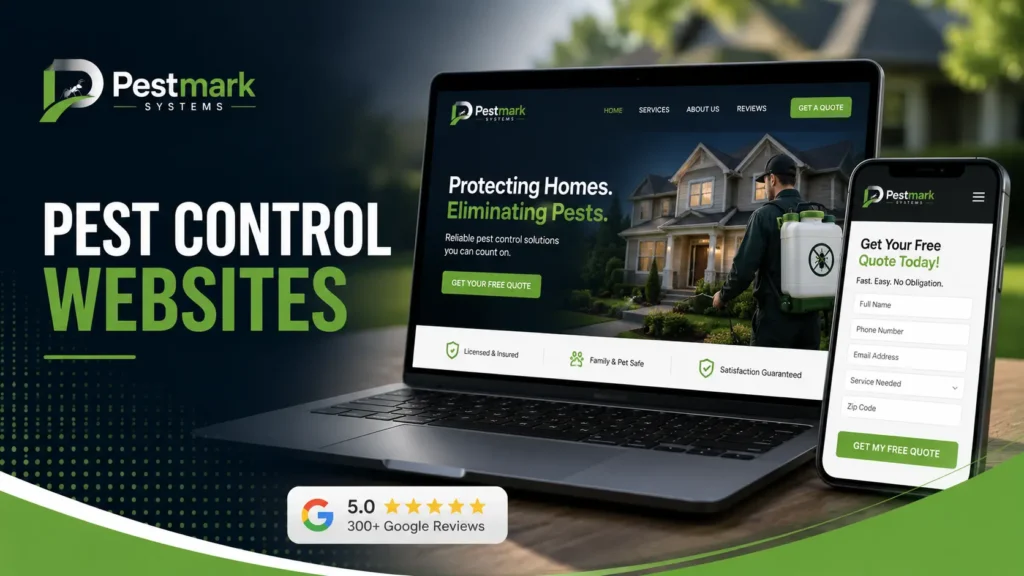
A clear value proposition above the fold. The moment someone lands on your homepage, they should immediately understand who you are, where you serve, and what makes you worth calling. “Trusted Pest Control in [City], [State] — Same-Day Service Available” does more work in five seconds than a flashy hero image with no context.
Service-specific pages. Each pest you treat — termites, rodents, bed bugs, mosquitoes, ants, cockroaches — deserves its own dedicated page. This is critical for both SEO and conversion. A homeowner searching “termite inspection near me” who lands on a generic “services” page is far less likely to call than one who lands on a page specifically about termite treatment, written in a way that speaks directly to their concern.
Local proof. Reviews, service area maps, years in business, certifications, and photos of your actual team all signal to a first-time visitor that you’re a real, established business operating in their community. This matters enormously in a trust-driven industry like pest control.
Essential Features Every Pest Control Website Needs
Beyond the foundational concepts, there are specific features that pest control websites require to perform well. If any of these are missing from your current site, you’re leaving leads on the table.
Click-to-call button, always visible. On both desktop and mobile, your phone number should be prominently displayed and clickable at all times. The header, the footer, and multiple points throughout every page. Don’t make visitors hunt for it. The moment they’re ready to call, friction costs you the job.
Quote or contact forms on every key page. Not just a contact page buried in the navigation. Every service page, every location page, should have a short, frictionless form — ideally asking for a name, phone number, service needed, and city. Keep it simple. A 10-field form will be abandoned.
Service area pages. If you serve multiple cities, each city deserves a dedicated landing page optimized for local keywords. A page for “pest control in Austin” and a separate page for “pest control in Round Rock” will outperform a single page that vaguely lists both cities. These pages need to include local information, not just the city name swapped out.
Trust signals throughout. Certifications from organizations like the National Pest Management Association (NPMA), state licensing information, Google review ratings, years in business, and guarantees should appear consistently across your site — especially near your call-to-action elements.
FAQ sections on service pages. Homeowners have questions before they call. “How long does termite treatment take?” “Is the treatment safe for pets?” Answering these on your service pages builds confidence, reduces friction, and improves your chances of ranking in search results, including Google’s AI-generated answer snippets.
Schema markup. This is the technical layer of your website that helps Google understand your business — your service area, your reviews, your FAQs. It’s invisible to visitors but significant for search visibility. Ask your web developer or platform provider whether your site is using LocalBusiness and FAQ schema.
Mobile Optimization for Pest Control Companies
More than 60% of pest control website visitors arrive on a mobile device. When a homeowner discovers cockroaches in the kitchen at 9 PM, they reach for their phone — not their laptop. If your website isn’t fast, clean, and easy to navigate on a smartphone, you’re losing those leads the moment the page loads.
Mobile optimization isn’t just about having a “responsive” website that shrinks to fit a smaller screen. It means designing specifically for mobile behavior. That means:
Your click-to-call button should be large enough to tap easily with a thumb, and it should float or remain fixed so it’s always accessible without scrolling. Your contact form fields should be large enough to tap without pinching and zooming. Images should be compressed so they don’t slow down the page. Text should be readable without zooming in.
A practical test: pull up your own website on your phone right now. Can you find the phone number in two seconds? Can you complete the contact form without frustration? If the answer to either question is no, you have a problem that’s costing you real leads every single day.
Google also uses mobile performance as a ranking factor, which means a poor mobile experience doesn’t just lose you conversions — it hurts your ability to show up in search results in the first place.
How Reviews Increase Conversion Rates
In the pest control industry, trust is the purchase decision. A homeowner letting a technician into their home wants to know they’re choosing a company that’s professional, reliable, and honest. Reviews are the fastest way to establish that trust with someone who’s never heard of you.
The research is consistent: businesses with a high volume of recent, positive Google reviews convert significantly better than those with few or outdated reviews. A pest control company with 200+ Google reviews and an average of 4.7 stars will outperform a competitor with 30 reviews every time — even if both companies offer identical services at identical service levels.
Here’s what most pest control companies get wrong about reviews: they treat them as passive. They hope satisfied customers will leave one. But satisfied customers are busy. The ones motivated to write reviews without being asked are usually the ones who are frustrated.
An effective review strategy is systematic. It sends a follow-up text or email after every completed job, makes it easy for the customer to click directly to your Google Business Profile, and does this consistently across every technician and every route. Companies that build this into their post-job process see review counts grow steadily month over month.
Your website’s role is to display those reviews prominently. A review widget on your homepage that pulls in your current Google rating, testimonials on service pages for specific pest types, and a dedicated testimonials section all contribute to conversion. When a homeowner sees that 312 of their neighbors have trusted you — and they’re satisfied — the decision becomes much easier.
Why Speed Matters for Lead Generation
Website speed is not a technical detail. It’s a conversion factor with a direct, measurable impact on how many leads your site generates.
Google’s research has consistently shown that when a mobile page takes more than three seconds to load, a significant portion of visitors leave before it finishes. In pest control, where urgency is often high and patience is low, a slow website is a direct revenue loss.
Page speed affects your business in two interconnected ways. First, it affects your search rankings — Google uses Core Web Vitals as part of its ranking algorithm, and a slow site will rank lower than a faster competitor, meaning fewer people find you in the first place. Second, it affects what happens once people do find you — a slow page sends visitors back to the search results to click on a competitor.
Common speed killers on pest control websites include oversized images that haven’t been compressed, too many third-party scripts loading simultaneously, cheap or shared hosting that can’t handle traffic spikes, and page builders that generate bloated code.
A practical benchmark: aim for a page load time under 2.5 seconds on mobile, and score a “Good” rating on Google’s Core Web Vitals for Largest Contentful Paint (LCP) and Cumulative Layout Shift (CLS). Your web developer or a tool like Google PageSpeed Insights can measure these for free.
Integrating Booking Forms and CRM Systems
A lead generated by your website is only valuable if it gets followed up on quickly. Industry data shows that response time is one of the strongest predictors of whether a lead converts to a booked job. Calling a lead back within five minutes of form submission dramatically outperforms calling them back an hour later.
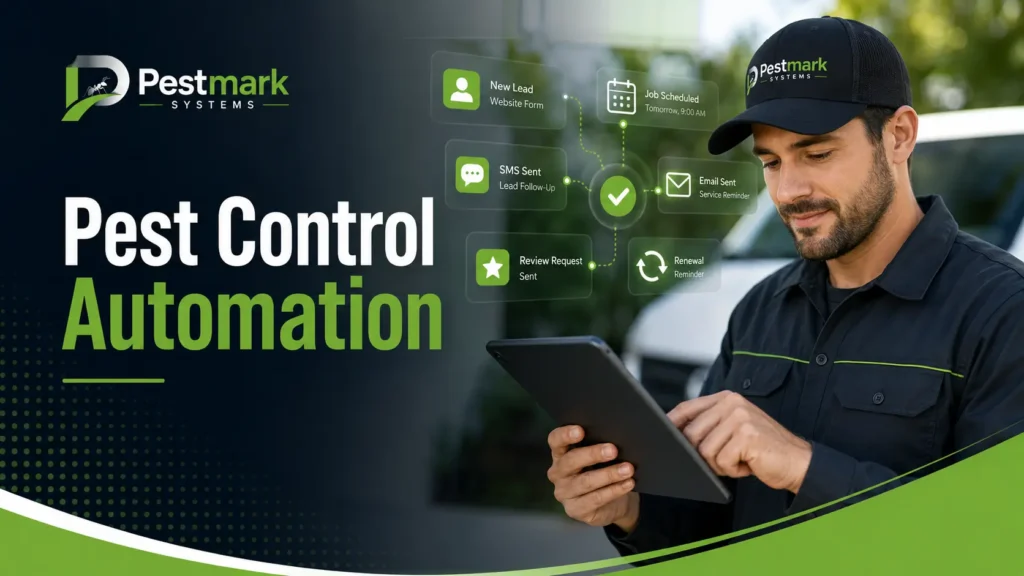
This is where integrating your website’s contact forms with a CRM (Customer Relationship Management) system becomes critical for growth-minded pest control companies. When a homeowner submits a quote request on your website, that information should flow automatically into your CRM or scheduling system — not sit in an email inbox that might not be checked for hours.
Modern pest control software platforms often include built-in CRM features. Many also integrate with tools like Zapier, which can connect your web form submissions to your preferred follow-up system and trigger an automatic text message to the lead within seconds of form submission.
At minimum, your website should:
- Deliver form submissions to a monitored inbox and to your phone via SMS notification
- Include a confirmation message that sets expectations (“We’ll call you within the hour”)
- Capture the lead’s phone number so you can follow up by text, not just email
Companies that close the loop between website lead capture and fast follow-up consistently see higher conversion rates from the same volume of traffic. The website generates the opportunity; the system is what turns it into revenue.
Comparison: Basic Pest Control Website vs. Lead-Optimized Website
|
Feature |
Basic Website |
Lead-Optimized Website |
|
Homepage CTA |
Generic “Contact Us” link |
Prominent call button + quote form above the fold |
|
Service pages |
One generic “Services” page |
Individual pages per pest (termites, rodents, bed bugs, etc.) |
|
Location coverage |
City name mentioned on homepage |
Dedicated city/service-area landing pages |
|
Mobile experience |
Responsive layout only |
Designed and tested for mobile-first conversions |
|
Reviews |
Not displayed |
Google rating widget + testimonials on key pages |
|
Page speed |
5–8 second load time |
Under 2.5 seconds on mobile |
|
Trust signals |
Logo and phone number |
Certifications, guarantees, years in business, team photos |
|
Form integration |
Email delivery only |
CRM integration + instant SMS notification |
|
FAQ content |
None |
FAQ sections on every service page with schema markup |
|
Analytics |
Basic page views |
Call tracking + form conversion tracking |
Common Mistakes Pest Control Companies Make
Even well-intentioned website investments go wrong when certain mistakes aren’t avoided. Here are the ones that show up most consistently in pest control websites that underperform.
Relying on a generic website template. Pest control is a local, trust-driven business. A template designed for a software company or a retail brand won’t communicate what your ideal customer needs to feel confident calling you. Your site needs to be built with pest control lead generation in mind from the start.
No call tracking. If you don’t know which pages or keywords are generating phone calls, you can’t make informed decisions about your website or your marketing budget. Call tracking software assigns unique phone numbers to different traffic sources, letting you see exactly what’s working.
Ignoring Google Business Profile. Your Google Business Profile (formerly Google My Business) is deeply connected to your website’s local search performance. A neglected or incomplete profile means you’ll underperform in local pack results — the map listings that appear above organic search results for high-intent local queries. Your profile and your website need to work together.
Duplicate city pages with no unique content. Having service area pages is correct strategy. Copy-pasting the same content with only the city name changed is a mistake that Google can detect and penalize. Each location page needs genuine, locally relevant content to do its job.
No strategy for emergency searches. Searches like “emergency pest control near me” and “same day exterminator” represent some of the highest-intent traffic a pest control website can capture. If your website doesn’t speak to urgency — with language, CTAs, and content that addresses same-day or emergency service — you’re missing those opportunities entirely.
Building a Website That Supports Long-Term Growth
A pest control website isn’t a one-time project. It’s an asset that, if built and maintained correctly, compounds value over time. The companies that grow steadily through organic search are the ones that treat their website as an ongoing investment rather than a finished product.
Long-term growth comes from a combination of the right technical foundation, consistent content additions, and regular optimization based on real data.
On the content side, this means adding new service-specific pages as you expand your offerings, publishing answers to the questions your customers actually ask, and keeping your city pages current and relevant. Every new piece of well-structured content is another opportunity to rank for a search that brings in a qualified lead.
On the technical side, it means auditing your site periodically for speed issues, broken links, and outdated information. Your website from three years ago may have been fine then — but the standards for mobile performance, schema markup, and page structure have evolved.
On the data side, it means having Google Analytics, Google Search Console, and call tracking set up and actually reviewed on a monthly basis. You can’t improve what you’re not measuring. Understanding which pages convert, which keywords bring in qualified traffic, and where visitors are dropping off is what separates companies that grow predictably from those that wonder why their marketing isn’t working.
The pest control companies winning in their local markets right now have websites that were built with strategy, maintained with consistency, and optimized based on real results. That’s the standard worth working toward.
Frequently Asked Questions
What pages does a pest control website absolutely need?
At minimum: a homepage, individual service pages for each pest type you treat, a service area page for each city you serve, an about page, and a contact page. A blog or resource section can further support long-term SEO growth.
How do I get my pest control website to rank on Google?
Local SEO for pest control is built on three pillars: a well-structured website targeting relevant keywords, a fully optimized Google Business Profile, and a steady stream of positive customer reviews.
Should I use a quote form or a phone number as my primary CTA?
Both. Some visitors prefer calling immediately, while others would rather request a quote online. Display a click-to-call number and a short quote form on every important page.
How many reviews does my pest control company need?
There is no magic number, but in most markets, 50+ reviews with a 4.5-star rating or higher is enough to compete effectively. Consistently collecting new reviews is just as important as the total count.
Does my pest control website need a blog?
While not required at launch, a blog helps build long-term search visibility. Educational articles answering common customer questions can attract traffic and position your company as a trusted local authority.
How do I track which marketing is generating my leads?
Use call tracking software and Google Analytics to measure calls, form submissions, and conversions. This allows you to see which channels, campaigns, and pages are producing real leads.
What’s the biggest difference between a pest control website and a lead-generation website?
A standard website provides information. A lead-generation website is designed to encourage action. Every element—from headlines and reviews to forms and page speed—is optimized to generate calls, quote requests, and booked jobs.
Ready to Turn Your Website Into a Lead-Generation Machine?
At PestMark Systems, we specialize in helping pest control companies build the systems, websites, and automation that turn online visibility into booked jobs. Whether you’re starting from scratch or trying to get more out of an existing site, we’d love to show you what’s possible.
Book a free Pest Control Automation Session and we’ll walk through your current online presence, identify your biggest conversion opportunities, and show you exactly what it would take to generate more calls from your market.