Table of Contents
Quick Answer
Pest control automation helps businesses save time and capture more leads by automating repetitive tasks such as lead response, scheduling, customer follow-up, invoicing, review requests, and renewal reminders.
Instead of relying on manual processes, automation ensures every lead receives a fast response, every customer gets consistent communication, and every opportunity is tracked automatically. The result is a more efficient pest control business that can grow without adding additional office staff.
Introduction
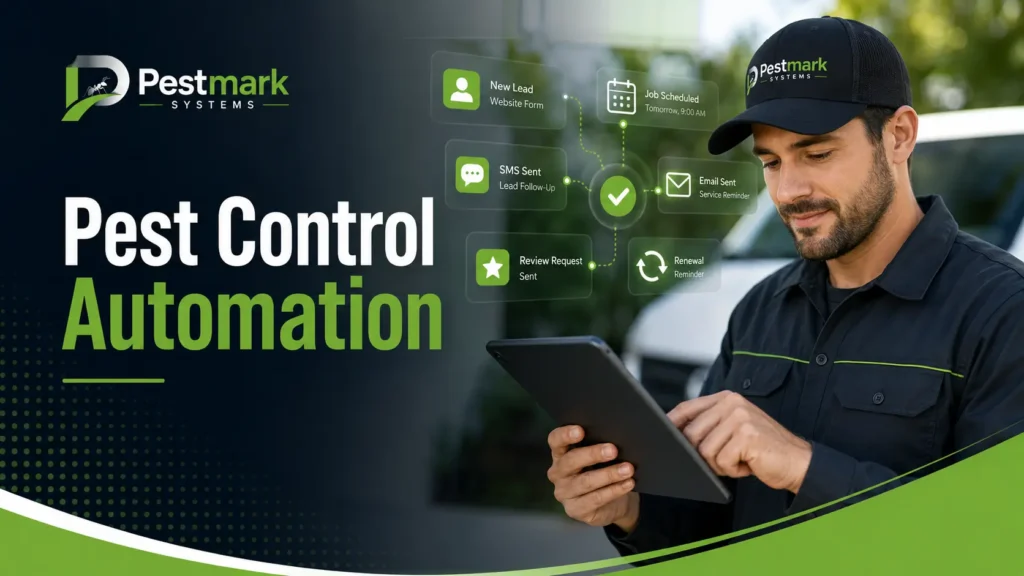
Running a pest control company has never been more competitive. Homeowners expect fast responses, seamless scheduling, and proactive communication. At the same time, the back office keeps growing: missed calls, manual follow-ups, forgotten renewal reminders, and technicians waiting on route changes eat hours every week. Pest control automation changes that equation. Instead of relying on your office staff to catch every lead, send every reminder, and request every review, you build systems that do it automatically—every time, without fail. This guide explains exactly how automation works in a pest control business, which areas deliver the fastest return on investment, which tools are leading the market, and how to avoid the most common implementation mistakes. Whether you run a two-technician operation or a multi-location company, there are automations in this guide you can put into practice this week.What Is Pest Control Automation?
Pest control automation is the use of software, digital workflows, and integrated systems to replace manual, repetitive tasks in your business. Instead of a person manually dialing back every missed call, typing a lead into a spreadsheet, and sending a reminder the day before a scheduled service, automated workflows handle each of those steps instantly and consistently. Automation in pest control falls into two broad categories:- Operational automation: scheduling, routing, dispatching, invoicing, and compliance documentation.
- Marketing and communication automation: lead capture, follow-up sequences, review requests, renewal reminders, and reactivation campaigns.
Why Pest Control Companies Are Turning to Automation
The shift toward automation in field service industries has accelerated dramatically. According to industry research, 70% of field service organizations have already invested in artificial intelligence and machine learning—and pest control is no exception. The reasons are straightforward:| 📊 78% of customers buy from the first company that responds to their inquiry. Speed-to-lead is no longer optional—it’s the primary competitive advantage in local service markets. |
| 📊 82% of customers expect a reply within 10 minutes. The average business response time, however, is more than 42 hours. Automation closes that gap completely. |
| 📊 93% of field service technicians report that technology has made them more productive—supporting automation as an operational investment, not just a marketing tool. |
The Hidden Cost of Manual Processes
Most pest control owners underestimate how much manual processes cost them—not just in payroll, but in lost revenue. Consider what happens on a typical busy Monday morning in a non-automated office:- Three website leads came in over the weekend. Two got a call back by noon. One was missed and went with a competitor.
- Two customers called to reschedule. One reached the office. The other left a voicemail that wasn’t returned until Tuesday.
- A technician called in sick. A dispatcher spent 90 minutes manually reassigning stops and notifying customers.
- Seven post-service review requests were supposed to go out last week. None did because the office manager forgot.
Areas of a Pest Control Business You Can Automate
Nearly every repeatable task in your operation is a candidate for automation. Here are the highest-impact areas, in order of priority for most pest control companies.Lead Capture
Every form on your website, every Facebook lead ad, and every Google Local Services Ad should flow directly into your CRM the moment it’s submitted—without a human touching it. Automated lead capture means:- Contact details are logged instantly in your CRM with no manual data entry.
- Leads are automatically tagged by service type and ZIP code.
- The right team member or pipeline stage is assigned based on routing rules you define.
Missed Call Text-Back
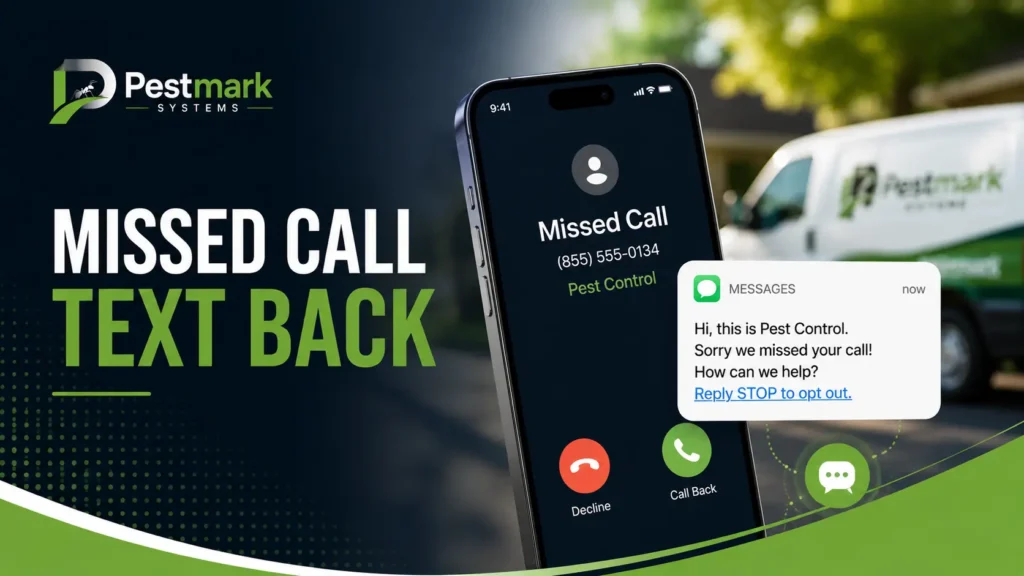
Missed calls are one of the most expensive problems in pest control. A homeowner dealing with a termite issue is not going to leave a voicemail and wait—they’re going to call the next number on Google. Missed-call text-back automation fires an SMS to the caller within seconds of a missed call. Something as simple as: “Hi, this is [Company Name]. Sorry we missed you! We’d love to help. Click here to schedule or reply with your question.” That single automation recovers leads that would otherwise be lost forever.| 📊 Responding to a lead within 1 minute can increase conversion rates by up to 391% compared to waiting 30 minutes or more. Missed-call text-back puts you in that window automatically, even after hours. |
Appointment Scheduling
Manual scheduling creates bottlenecks. Customers call, wait on hold, get transferred, and then wait for a confirmation call. Scheduling automation replaces this with:- Online booking links that let customers choose their own time slot from your live calendar.
- Automated confirmation emails and SMS messages sent immediately after booking.
- Reminder sequences that fire 48 hours, 24 hours, and 2 hours before the appointment.
Customer Follow-Up
Most pest control companies follow up with new leads once or twice. High-performing companies build multi-touch sequences that contact leads over 7–14 days through a mix of SMS, email, and even voicemail drops. After a service visit, follow-up sequences can check in on satisfaction, reinforce the value of recurring plans, and set expectations for the next scheduled service.Review Requests
Online reviews directly impact your Google Maps ranking, click-through rate, and close rate. Yet most pest control companies rely on individual employees to remember to ask—which means reviews are inconsistent and low-volume. Automated review requests send a personalized SMS to every customer a few hours after service completion. With a simple link to Google or Facebook, customers can leave a review in under two minutes. Companies that implement this consistently report dramatic increases in monthly review volume within weeks.Estimate Requests
When a prospect requests a quote online or over the phone, automation can trigger an immediate acknowledgment, collect the information needed to prepare an estimate, and follow up if no appointment is booked within 48 hours. Automated estimate workflows shorten the sales cycle and reduce the number of leads that go cold while waiting for a manual response.Technician Communication
Your technicians shouldn’t need to call the office to find out where they’re going next. Scheduling and dispatch software sends job details, customer notes, service history, and route updates directly to a mobile app. When a job is completed, the technician can close it out in the field—automatically triggering the invoice and review request without any office involvement.Renewal Reminders
Recurring service agreements are the foundation of a scalable pest control business. Automation protects that revenue by sending renewal reminders via SMS and email as contracts approach expiration. A three-step sequence—30 days out, 14 days out, and 3 days out—can recover a significant portion of customers who would otherwise lapse without realizing it.Customer Reactivation
Every pest control company has a list of customers who haven’t booked in 12 months or more. These are warm leads—people who already trust your brand—but they’ve gone quiet. Automated win-back campaigns send targeted messages to lapsed customers, often with a seasonal offer or friendly reminder. Reactivating even a small percentage of this list generates immediate revenue with zero ad spend.Manual vs. Automated Pest Control Operations
The table below illustrates the operational difference between a manual and an automated pest control company across the most common business processes:| Process | ❌ Manual | ✅ Automated |
| Lead Response | Hours later, inconsistent | Instant SMS/email + routing |
| Scheduling | Phone calls & spreadsheets | Real-time calendar & dispatch |
| Technician Routing | Manual map planning | Optimized routes by ZIP/service area |
| Review Requests | Staff remembers to ask | Automatic post-job review request |
| Recurring Service | Renewal reminders by hand | Scheduled reminder sequences |
| Invoicing | Paperwork & follow-up calls | Digital invoicing & payment links |
| Customer Follow-Up | Manual emails or calls | Automated SMS/email sequences |
| Reactivation | Rarely done | Win-back campaigns on autopilot |
The Best Automation Tools for Pest Control Companies
The right tool stack depends on your company size, budget, and growth stage. Here are the most commonly used platforms in the pest control industry: FieldRoutes: Purpose-built for pest control, FieldRoutes combines CRM, scheduling, routing, billing, and recurring service management in one platform. It focuses on eliminating repetitive office work and giving both field and office teams a centralized view of customer data. ServiceTitan: A leading field service platform used by mid-to-large pest control companies. Covers scheduling, dispatch, invoicing, and reporting with strong technician mobile tools. Jobber: Popular with smaller and growing companies. Jobber is user-friendly and covers quoting, scheduling, invoicing, and basic CRM with good mobile usability. HubSpot: A flexible CRM that excels at marketing automation, lead pipelines, and email/SMS sequences. Works well as a standalone CRM layer connected to scheduling software via integrations. Zoho CRM / Freshsales: Affordable, configurable CRM platforms with built-in automation for lead routing, follow-up sequences, and pipeline management. A good fit for companies not yet ready for an all-in-one field service solution. Podium: Specializes in customer messaging, review generation, and two-way SMS. Often used alongside a primary CRM to manage customer communication and online reputation. For most pest control companies, the most effective approach is one core platform (FieldRoutes, ServiceTitan, or Jobber) combined with a communication layer (Podium or a similar tool) and a CRM if the primary platform’s pipeline management falls short.How Automation Improves Customer Experience
Automation is often sold as a cost-cutting tool, but its impact on customer experience is equally significant. Consider what automated workflows deliver from a customer’s perspective:- Instant acknowledgment: they submit a form and receive a message within seconds—not hours.
- Convenient scheduling: they book online at their preferred time without waiting on hold.
- Proactive reminders: they receive a reminder the day before their appointment, reducing the chance they’ll forget.
- Real-time arrival notifications: they know when the technician is on the way.
- Immediate invoicing: they receive a digital invoice and payment link as soon as the job is complete.
- Renewal reminders: they’re prompted to renew before their protection lapses, rather than realizing it after the fact.
| 📊 67% of field service customers say they want faster response times. Automation doesn’t just speed up your internal operations—it directly delivers the experience customers are asking for. |
How Automation Increases Revenue
The revenue impact of pest control automation operates across four levers: more leads converted, fewer customers lost, more recurring revenue retained, and higher technician efficiency.Faster Lead Response = More Bookings
If your office responds to leads within 5 minutes instead of several hours, your conversion rate can more than double. For a company receiving 100 leads per month at a $250 average job value, even a 10% improvement in conversion rate generates $2,500 in additional monthly revenue—$30,000 annually—without spending a dollar more on advertising.Retention = Compounding Revenue
Recurring service agreements are exponentially more valuable than one-time jobs. If your average quarterly plan is worth $600 per year and automation improves your retention rate by even 5 percentage points, every 100 recurring customers represents $3,000 in annual revenue protected. As your customer base grows, the compounding effect becomes significant.Review Volume = More Organic Leads
A higher Google review count improves your ranking in the Local Pack—the top three businesses shown in map-based searches. More visibility means more inbound calls with no ad spend. For competitive markets, a 50-review lead over a competitor can translate to significantly higher organic call volume.Route Optimization = More Jobs Per Day
Automated routing reduces drive time between jobs. A technician who completes 6 jobs per day instead of 5—because the route is optimized—generates 20% more revenue per technician. Across a team of 5 technicians at $200 per job, that’s a $200,000+ annual revenue increase from routing efficiency alone.Common Mistakes to Avoid When Implementing Automation
Automation fails when it’s implemented incorrectly. These are the mistakes that cost pest control companies time and money:- Automating broken processes. If your lead routing is unclear or your scheduling workflow has gaps, automation will make the problem faster—not better. Fix the process first, then automate it.
- Using too many disconnected tools. Five separate apps that don’t talk to each other create more manual work, not less. Prioritize platforms with native integrations or a single all-in-one solution.
- Skipping lead routing rules. Without defined rules for who handles which lead and when, leads fall between the cracks even with automation. Set clear ownership before you go live.
- Not tracking KPIs. If you don’t measure lead response time, booking rate, and retention before and after implementation, you can’t evaluate ROI or optimize your workflows.
- Over-automating communication. Too many automated messages feel spammy and damage trust. Every workflow should feel personal and purposeful. Limit follow-up sequences to 3–5 touches over 7–14 days.
- Ignoring technician adoption. Automation only works in the field if your technicians use the mobile app consistently. Invest in onboarding and make sure the interface is simple.
- Forgetting recurring service workflows. Most automation attention goes to new leads. But recurring service renewals are where the real money is. Build renewal reminder and reactivation sequences early.
- Not connecting your systems. CRM, phone, scheduling, and billing need to share data. If your scheduling software doesn’t talk to your CRM, you’re creating manual reconciliation work instead of eliminating it.
How to Get Started With Pest Control Automation
Implementing automation doesn’t have to be overwhelming. Follow this sequence to build momentum quickly and avoid the most common mistakes: Step 1: Audit your current workflows. Write down every repetitive task your office handles in a week. This becomes your automation priority list. Step 2: Start with speed-to-lead. Missed-call text-back and instant web lead acknowledgment deliver the fastest, most measurable ROI. Get these live first. Step 3: Choose your core platform. Based on your company size and budget, select one primary platform (FieldRoutes, Jobber, or ServiceTitan). Don’t try to build a multi-tool stack until you’ve mastered one system. Step 4: Build your follow-up sequences. Create a 3–5 step SMS and email sequence for new leads. Add a post-service satisfaction and review request sequence. These two alone will outperform most manual follow-up efforts. Step 5: Automate recurring service reminders. Set up renewal reminder sequences for all active recurring plans. This step alone can materially improve your retention rate. Step 6: Track and optimize. Monitor lead response time, booking rate, retention rate, and review volume monthly. Adjust sequences and routing rules based on what the data shows.Frequently Asked Questions
What is pest control automation?
Pest control automation is the use of software, digital workflows, and integrated systems to replace repetitive manual tasks such as lead capture, scheduling, follow-up, invoicing, review requests, and renewal reminders. Automation helps pest control companies operate more efficiently while providing a faster and more consistent customer experience.
What should a pest control company automate first?
Most pest control companies should start with missed-call text-back, instant lead response, appointment reminders, review requests, and recurring service reminders. These automations typically deliver the fastest return on investment and are relatively easy to implement.
Does automation work for small pest control businesses?
Yes. Small pest control companies often see the biggest impact because automation reduces administrative workload and helps them compete with larger companies without hiring additional office staff.
Can automation help generate more Google reviews?
Absolutely. Automated review request workflows ensure every customer receives a review invitation after service completion, increasing review volume and helping improve local search visibility.
How much can pest control automation increase revenue?
Automation can increase revenue by improving lead conversion rates, reducing customer churn, increasing review volume, protecting recurring service agreements, and helping technicians complete more jobs each day through better scheduling and routing.
Conclusion
Pest control automation is not about replacing people. It’s about making sure every lead gets a fast response, every customer receives consistent communication, and every technician has the information they need—without your office staff manually handling every step.
The companies winning in today’s pest control market are not always the ones with the biggest teams or largest advertising budgets. They’re the businesses that respond faster, follow up more consistently, and retain customers more effectively. Automation creates the systems that make that possible at scale.
You don’t need to automate everything at once. Start with missed-call text-back and a simple lead follow-up sequence. Measure the results, optimize what works, and expand from there. Within a few months, you’ll have a clear picture of which automations are generating the highest return—and a foundation that supports long-term growth.
Get Your Free Automation Audit →